Excerpt from The Prelude
Dive into the psychological depths of Wordsworth's 'The Prelude', a masterpiece of Romantic poetry. This guide will help you unpack the profound impact of nature on the human mind, ensuring you can confidently analyse the sublime and secure top marks.
Study Notes
Overview
William Wordsworth's The Prelude is a monumental autobiographical poem that traces the growth of the poet's mind. The extract commonly studied at GCSE, often referred to as the 'boat-stealing episode', is a vivid recollection of a childhood transgression. It captures a moment where the young Wordsworth, having stolen a boat, experiences a terrifying vision of a huge mountain peak. Examiners are looking for candidates who can unpack the psychological complexity of this event, specifically how Wordsworth uses language and structure to convey the transition from innocent joy to overwhelming guilt and fear. A strong response will demonstrate an understanding of the Romantic concept of the 'sublime' and how nature acts as a powerful moral teacher.
Plot/Content Overview
The extract follows a clear narrative arc:
- The Transgression: The speaker finds a boat tied to a willow tree on a summer evening and decides to take it ("an act of stealth").
- The Journey Out: He rows confidently onto the lake, enjoying the beauty of the scene and feeling a sense of mastery as he aims for a fixed point on the horizon.
- The Turning Point: A "huge peak, black and huge" suddenly comes into view from behind the craggy ridge.
- The Terror: As he rows further, the peak appears to grow and stride after him like a living creature.
- The Retreat: Terrified, he rows back to the shore, leaves the boat, and walks home with a "heavy and a troubled heart."
- The Aftermath: For days afterwards, his mind is haunted by a "darkness" and "huge and mighty forms," marking a profound psychological change.
Themes
Theme 1: The Power of Nature and the Sublime
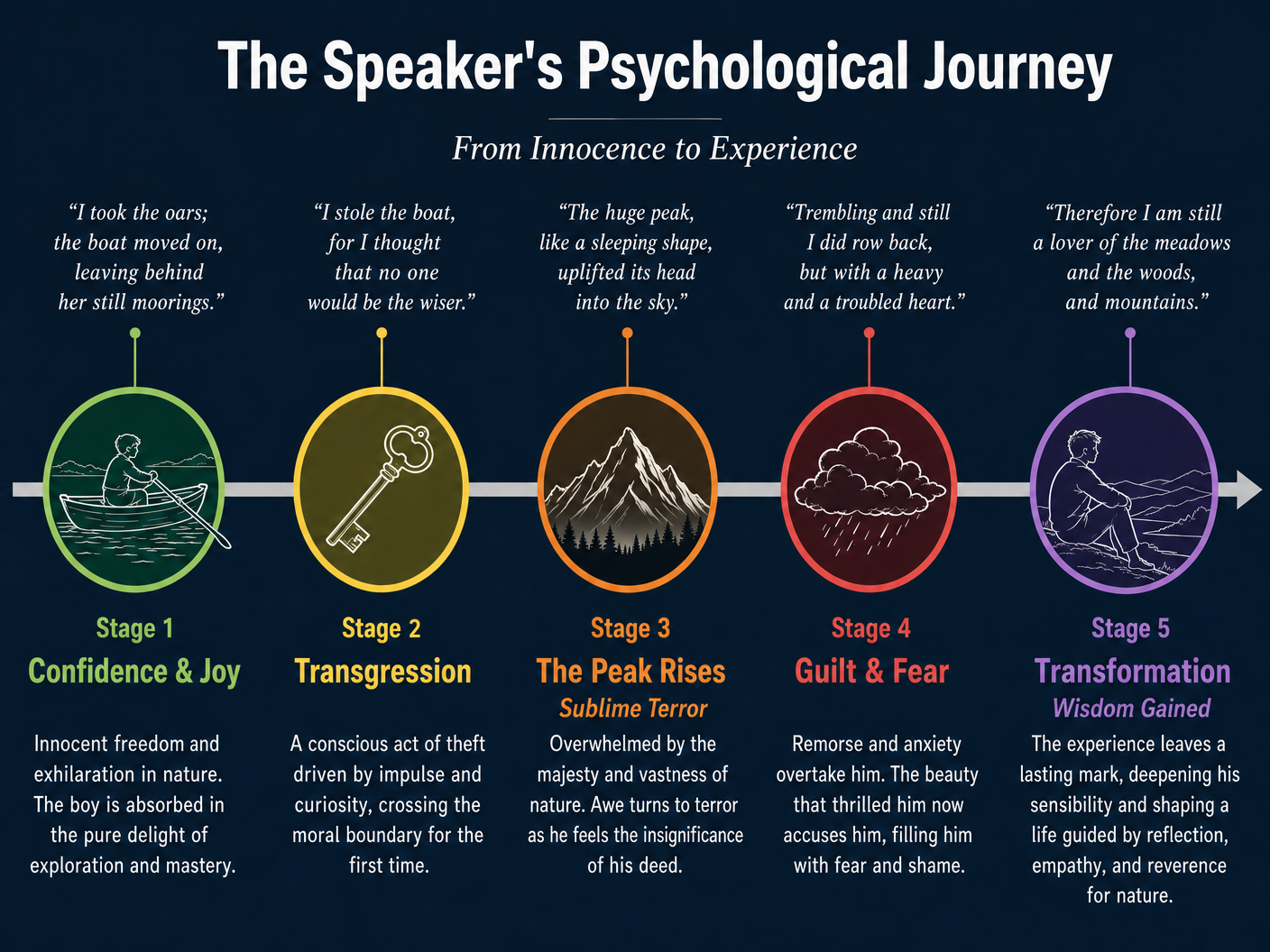
Nature in The Prelude is not merely a passive backdrop; it is an active, formidable force that shapes the speaker's consciousness. Wordsworth explores the 'sublime'—the awe-inspiring and terrifying power of the natural world that makes humanity feel insignificant.
Key Quotes:
- "a huge peak, black and huge" (Line 22) - The repetition of "huge" and the chiasmus trapping "black" in the middle emphasizes the overwhelming, menacing scale of the mountain.
- "upreared its head" (Line 23) - Personification gives the mountain a deliberate, aggressive action, transforming it from a geographical feature into an active, judging presence.
- "huge and mighty forms, that do not live / Like living men" (Lines 42-43) - This highlights the lingering psychological impact; nature has imprinted an alien, incomprehensible power onto his mind.
Theme 2: Guilt, Conscience, and Moral Awakening
The poem is a profound exploration of a guilty conscience. The physical landscape becomes a projection of the speaker's internal moral conflict.
Key Quotes:
- "an act of stealth / And troubled pleasure" (Lines 8-9) - The oxymoron "troubled pleasure" captures the complex thrill of transgression; he knows it is wrong, yet enjoys the act.
- "measured motion like a living thing, / Strode after me" (Lines 26-27) - The simile and verb "strode" reveal how his guilt distorts reality; he projects his fear of punishment onto the mountain, imagining it as a pursuer.
- "my brain / Worked with a dim and undetermined sense / Of unknown modes of being" (Lines 31-33) - The experience shatters his previously simple understanding of the world, introducing a complex moral and existential awareness.
Character Analysis
The Speaker (Young Wordsworth)
Role: The protagonist of this autobiographical memory, transitioning from innocence to experience.
Key Traits:
- Impulsive yet sensitive: Driven by the thrill of the moment but deeply affected by the psychological consequences.
- Imaginative: His mind readily transforms the natural landscape into a moral entity.
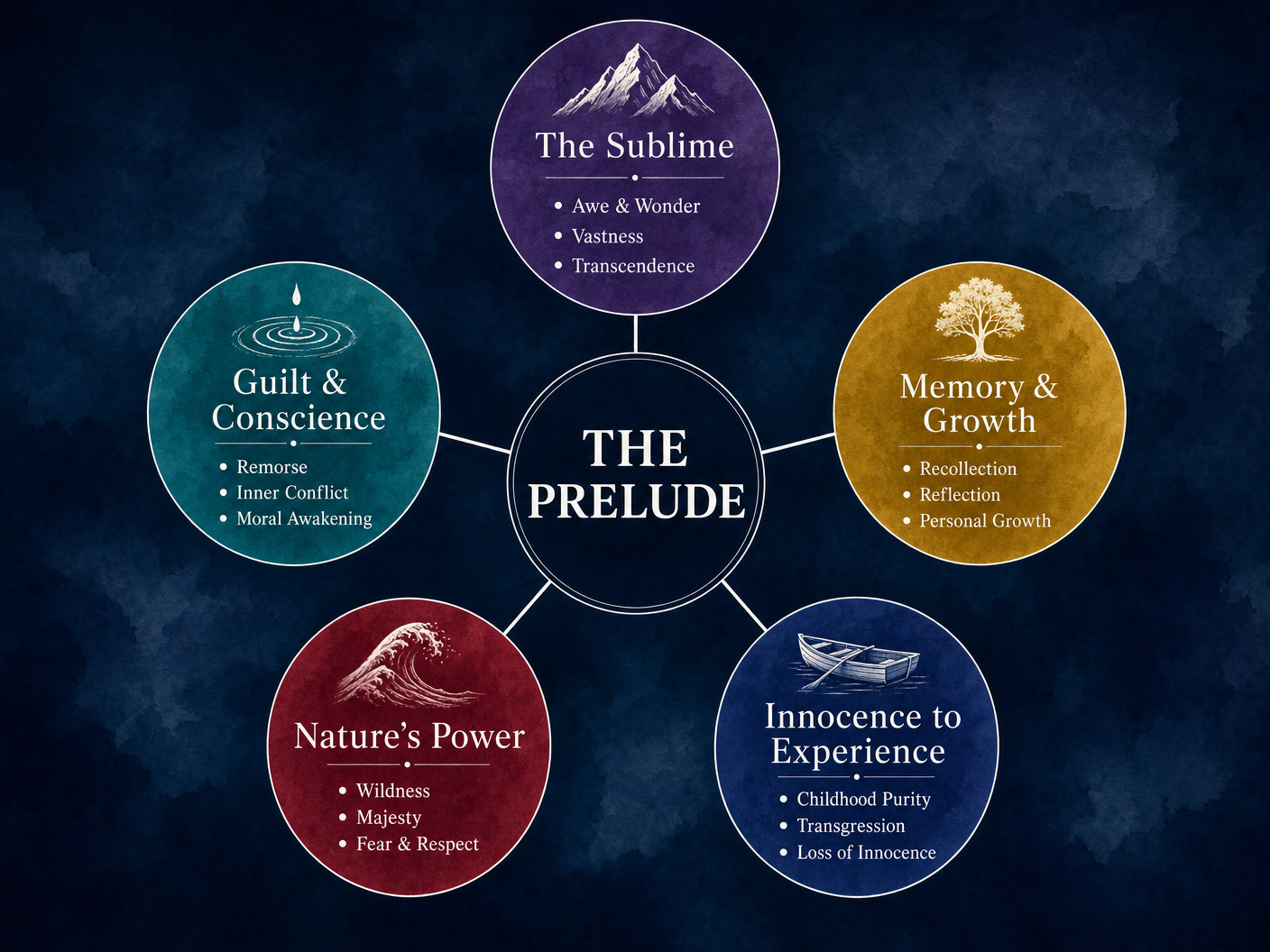
Character Arc: He begins with "troubled pleasure" and "proud" confidence, experiences sublime terror, and ends with a "heavy and a troubled heart," forever changed by the "darkness" of his new awareness.
Essential Quotes:
- "I took the oars: the guide's boat moved on;" (Line 5)
- "With trembling oars I turned" (Line 27)
- "There hung a darkness, call it solitude" (Line 35)
Writer's Methods
Wordsworth employs sophisticated techniques to convey this psychological journey:
- Form: The poem is written in blank verse (unrhymed iambic pentameter). This mimics natural speech, making it feel like a genuine, intimate confession or recollection, while elevating the personal experience to the status of epic poetry.
- Structure: The extensive use of enjambment (e.g., "I dipped my oars into the silent lake, / And, as I rose upon the stroke...") creates a flowing, breathless momentum, mirroring the physical act of rowing and, later, the speaker's rising panic.
- Language: The shift in tone is stark. It moves from sensory, beautiful imagery ("small circles glittering idly in the moon") to dark, oppressive language ("black," "grim," "darkness," "blank desertion").
- Narrative Perspective: The first-person retrospective narrative allows the adult poet to look back on his younger self, blending the immediacy of the child's terror with the adult's philosophical understanding of the event's significance.
Context
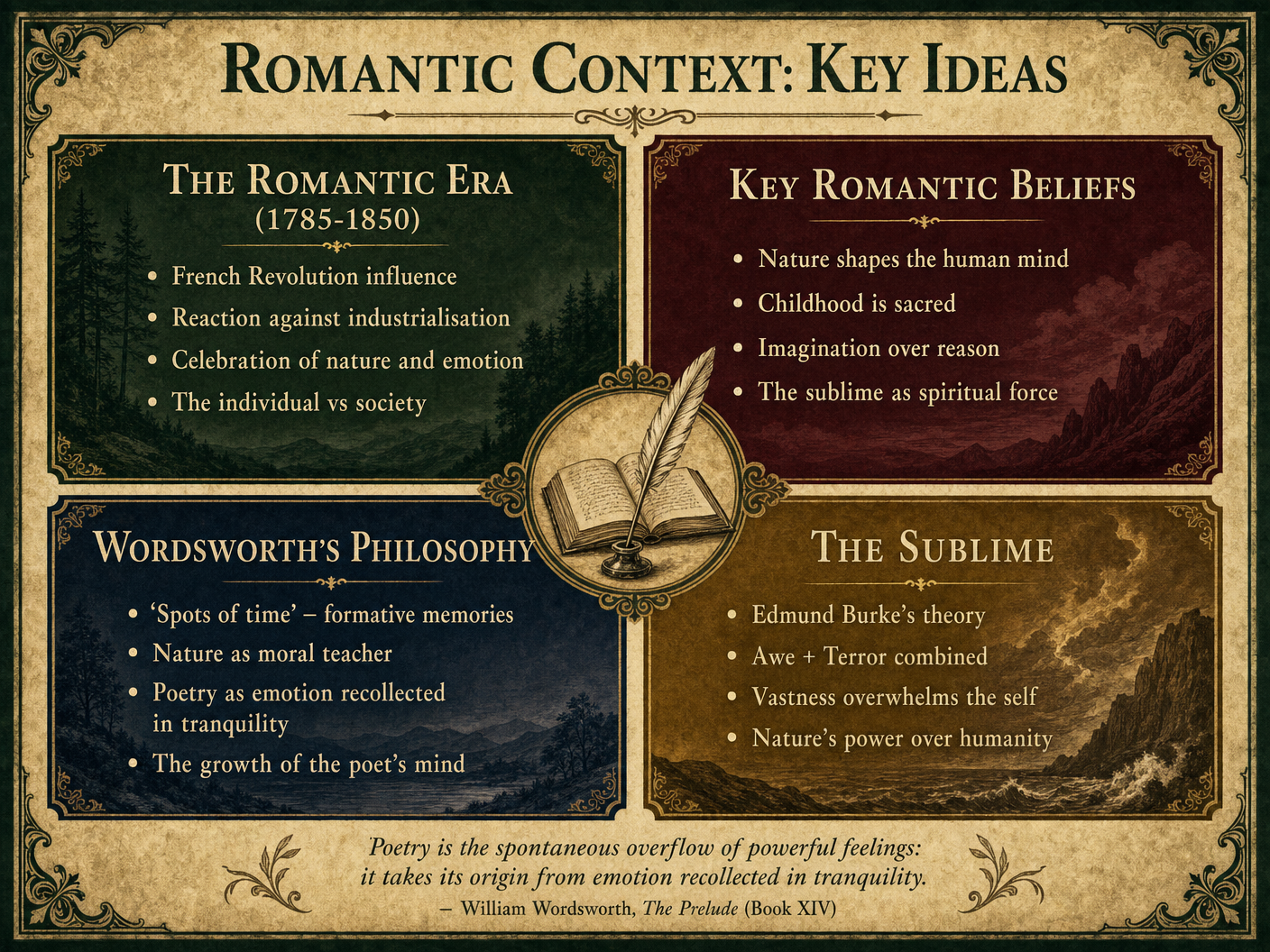
To achieve high marks for AO3, candidates must integrate context naturally. The Prelude is a quintessential Romantic text. The Romantics (writing roughly 1785-1850) reacted against the industrialisation and scientific rationalism of the Enlightenment. They believed:
- Nature as Teacher: Nature is a powerful moral and spiritual guide that shapes the human soul.
- The Sublime: Coined by Edmund Burke, the sublime is the feeling of awe and terror when confronting nature's vastness.
- Spots of Time: Wordsworth believed that intense childhood experiences (like this boat-stealing episode) leave a lasting imprint on the mind, shaping adult identity. This extract is a prime example of a 'spot of time'.
Visual Resources
3 diagrams and illustrations
Interactive Diagrams
1 interactive diagram to visualise key concepts
Conceptual Flow Outline
The Psychological Arc of The Prelude
Worked Examples
2 detailed examples with solutions and examiner commentary
Practice Questions
Test your understanding — click to reveal model answers
Compare how poets present the power of nature in The Prelude and one other poem from the Power and Conflict cluster.
Hint: Consider comparing with *Storm on the Island* (nature as a physical, aggressive force vs psychological force) or *Ozymandias* (nature outlasting human power).
How does Wordsworth present the theme of memory in The Prelude?
Hint: Focus on the narrative perspective (older self looking back) and the lasting impact of the event ('for many days').
Explore the significance of the setting in this extract from The Prelude.
Hint: Contrast the initial beautiful setting ('glittering idly') with the terrifying setting later ('craggy steep', 'huge peak').
How does Wordsworth use language and structure to create a sense of fear?
Hint: Look at the volta, the repetition of 'huge', and the use of enjambment to create panic.